
Baklava and baklawa are the same dessert; the difference is only in spelling, not the pastry itself. “Baklava” is the more common English and Turkish transliteration, while “baklawa” is the spelling more commonly used across Arabic-speaking regions of the Levant and Gulf. Both refer to the same layered, syrup-soaked pastry made with phyllo dough and chopped nuts.
If you also came across the search “baklava vs balaclava,” that one is unrelated: a balaclava is a knitted face covering, not a dessert, and is a separate word entirely from baklava or baklawa.
Walk into any Middle Eastern bakery and you will almost certainly find both desserts sitting side by side under the glass counter. Both are rooted in centuries of tradition, and both show up at weddings, holidays, and family tables across the region. Yet the two could not be more different once you take a bite. At Al-Basha, we serve both daily, and one of the most common questions our guests ask is simple: what actually separates knafeh from baklava, and which one should you try first?
This guide breaks down the origin, ingredients, texture, and taste of baklava and knafeh so you can make an informed choice the next time you are standing at a bakery counter or planning a dessert table for an event.
What Is Baklava?
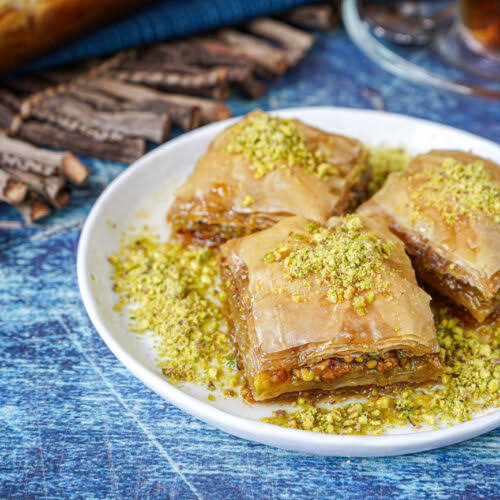
Baklava is built from stacked sheets of paper-thin phyllo dough, brushed layer by layer with melted butter, then filled with finely chopped nuts such as pistachios, walnuts, or almonds. Once baked until golden and crisp, the pastry is cut into diamond or square pieces and soaked in a sugar or honey syrup, often flavored with lemon or a hint of rosewater. The result is a dessert defined by contrast: shattering, flaky layers on the outside and a dense, nutty filling packed between them.
The history of baklava is long and genuinely contested among food historians, a debate we cover in more depth in our guide on whether baklava is Greek or Turkish. Layered pastries sweetened with honey and filled with nuts appear in records connected to the ancient Assyrian and Mesopotamian worlds and later in Byzantine and Roman cooking traditions. The version most people recognize today, however, is closely tied to the imperial kitchens of the Ottoman Empire, where palace chefs refined the technique of rolling dough paper-thin and layering it by hand.
From there, baklava spread across the empire’s territories, and nearly every region eventually developed its own version. Turkish baklava tends to favor pistachios and a lighter syrup, Greek baklava often leans on walnuts and cinnamon, and Levantine baklava frequently uses a blend of pistachios and orange blossom water. Regional differences aside, the defining structure of layered phyllo, nuts, and syrup has remained remarkably consistent for centuries.
What Is Knafeh?
Knafeh, also spelled kunafa, kanafeh, or kunefe depending on the region, is a completely different kind of pastry. Instead of layered phyllo sheets, knafeh is built with kataifi, a shredded pastry dough that looks similar to fine vermicelli noodles. That shredded dough is buttered, packed into a pan, and layered with a soft, mild cheese, most traditionally a salty white cheese such as nabulsi or akkawi.
The pastry is baked until the top turns deep golden and slightly crisp, then flipped, drenched in a fragrant syrup made with rosewater or orange blossom water, and finished with a scattering of crushed pistachios.
Knafeh’s roots trace back to the Levant, with many food historians pointing specifically to the Palestinian city of Nablus as its birthplace, which is why the classic version is still called knafeh nabulsieh. Early written references to shredded, cheese-filled pastries appear in Middle Eastern cookbooks dating back centuries, though the specific cheese-filled version most common today became widely documented later, around the nineteenth century.
Today knafeh is closely associated with Ramadan evenings, when families break their fast together, though it is enjoyed year-round across Palestine, Jordan, Lebanon, and Syria and increasingly across American cities with strong Middle Eastern communities.
Baklava vs Knafeh: The Core Differences
The most obvious difference between baklava and knafeh comes down to two things: the dough and the filling. The table below breaks down how they compare across the factors that matter most when choosing between them.
| Aspect | Baklava | Knafeh |
| Dough | Layered phyllo sheets | Shredded kataifi dough |
| Filling | Chopped nuts (pistachios, walnuts, almonds) | Soft white cheese (nabulsi or akkawi) |
| Serving temperature | Room temperature | Warm, shortly after baking |
| Texture | Crisp, flaky, structured layers | Soft, gooey center with a toasted top |
| Shelf life | Several days at room temperature | Best eaten fresh, texture changes once cooled |
| Best suited for | Gifting, catering, shipping, events planned in advance | Same-day gatherings, Ramadan, sit-down meals |
| Common origin region | Ottoman Empire, spread across Turkey, Greece, and the Levant | Levant, most closely tied to Nablus, Palestine |
There are also pastries that blur the line between the two. Balluriyeh, for example, is sometimes described as a cross between baklava and knafeh, using shredded kataifi dough in a rolled or layered format similar to baklava but without the cheese filling. This is a useful reminder that Middle Eastern pastry traditions are not always neatly divided into two boxes; regional bakers have spent generations experimenting with combinations of dough, nuts, and cheese.
Taste and Texture Compared
If you are trying to decide between the two based on flavor alone, it helps to think about what kind of dessert experience you are looking for.
Baklava delivers sweetness and crunch in a tight, structured bite. The nuts provide an earthy, slightly bitter counterpoint to the syrup, and the butter-soaked phyllo layers add richness without heaviness. It is a dessert you can eat slowly, savoring the crackle of each layer.
Knafeh is closer to a warm, gooey indulgence. The salty cheese filling balances the sweetness of the syrup in a way that few other desserts manage, and the shredded pastry on top provides a toasted, slightly crunchy contrast to the soft interior.
Where baklava is elegant and precise, knafeh is comforting and immediate, closer in spirit to a warm dessert you would want fresh out of the oven.
Neither dessert is objectively better; they simply deliver different experiences. Many Middle Eastern households and bakeries, including Al-Basha, serve both side by side specifically because they appeal to different moods and occasions.
Nutritional Comparison
A standard piece of baklava (60 to 100 grams) contains roughly 250 to 430 calories, according to nutrition data from the U.S. Department of Agriculture’s FoodData Central database, with most of those calories coming from fat and carbohydrates. Both desserts are indulgent by design, and neither is intended as an everyday food. The exact calorie count depends on the size of the piece and the ratio of nuts, butter, and syrup used in the recipe.
Knafeh’s nutritional profile shifts because of the cheese filling, which adds more saturated fat and protein compared to baklava’s nut-based filling, while its syrup contributes a similar amount of sugar. In practice, the two desserts land in a comparable calorie range per serving, so the choice between them should come down to taste preference rather than any meaningful nutritional advantage. For a broader look at how these desserts fit into the wider regional diet, see our guide on Mediterranean food origins, health, and calories.
Cultural Significance
Both desserts carry weight far beyond their ingredients. In Middle Eastern households, offering a guest a plate of baklava or knafeh is a gesture of hospitality, tied closely to celebrations such as weddings, Eid, and family gatherings.
Baklava has long been associated with generosity, often prepared in large trays and gifted to neighbors or shared during festive occasions. Knafeh carries a particularly strong connection to Ramadan, where its warm, comforting qualities make it a favorite dessert for breaking the fast with family.
At Al-Basha, we see this cultural weight reflected in what our guests order for different occasions. Baklava trays are a common choice for gifting, holiday tables, and catering orders that need to travel or sit out for a few hours. Knafeh, on the other hand, is frequently requested fresh and warm for gatherings happening that same day, particularly during Ramadan and other family celebrations.
How to Serve, Store, and Freeze Each Dessert
Baklava and knafeh are also handled differently once they leave the oven, which matters if you are planning ahead for an event.
Baklava is traditionally served alongside Arabic or Turkish coffee or a cup of black tea, both of which help balance its sweetness. It holds up well at room temperature for up to a week when stored in an airtight container.
It also freezes exceptionally well for up to two to three months, making it a practical make-ahead option for holidays or catering orders. Simply thaw it at room temperature before serving.
Knafeh is best served immediately after baking, often alongside the same syrup it was soaked in for extra sweetness on the side. It does not freeze or reheat as well as baklava, since the cheese filling changes texture once it has been chilled or frozen and thawed. You can see how we serve it fresh, along with the rest of our offerings, on our full menu. If you need to store leftover knafeh, refrigerate it in an airtight container and reheat gently in the oven rather than the microwave, which can make the pastry soggy.
On dietary restrictions, baklava’s nut-and-syrup filling is naturally vegetarian, though not vegan due to the butter used between the phyllo layers. Knafeh is also vegetarian but contains dairy in both the cheese filling and the butter used in the kataifi, so neither dessert is suitable for a vegan or dairy-free diet in its traditional form.
Which One Should You Choose?
If you are deciding between knafeh and baklava for an event, a gift, or simply your own curiosity, a few practical questions can help guide the decision.
If you need a dessert that travels well, holds up for a few days, and can be portioned into individual pieces for a crowd, baklava is the more practical choice. Its sturdy texture and long shelf life make it well suited for catering, gifting, and shipping.
If you want a warm, memorable dessert for an occasion where it can be served fresh, knafeh is worth the extra planning. Because it is best eaten shortly after baking, it works best for sit-down gatherings, family dinners, or events where the dessert can be served immediately.
Of course, you do not have to choose only one. Many of our customers at Al-Basha order both for larger events specifically because the contrast between crisp, nutty baklava and warm, cheesy knafeh gives guests two very different dessert experiences on the same table.
Try Both at Al-Basha
The best way to understand the difference between knafeh and baklava is to taste them side by side. At Al-Basha, we prepare both fresh using traditional methods, from hand-layered phyllo for our baklava to freshly shredded kataifi for our knafeh, so you can experience the real texture and flavor differences described in this guide.
Whether you are Team Baklava, Team Knafeh, or simply cannot decide, visit Al-Basha to taste the difference for yourself.
Final Thoughts
Knafeh and baklava represent two different sides of Middle Eastern dessert tradition: one is crisp, nutty, and built to last; the other is warm, cheesy, and best enjoyed fresh. Understanding their differences in dough, filling, texture, and history makes it easier to choose the right dessert for the right moment, whether that is a holiday tray, a warm family dinner, or simply a craving you want to satisfy. At Al-Basha, we recommend trying both, because the real answer to “knafeh vs baklava” usually is not one or the other. It is both, served together, exactly the way they have been enjoyed across Middle Eastern tables for generations.
Frequently Asked Questions
Baklava vs baklawa: which spelling is correct?
Both spellings are correct, and neither is more “right” than the other. Baklava and baklawa refer to the exact same pastry; the spelling simply reflects regional transliteration, with baklava more common in English and Turkish and baklawa more common in Arabic-speaking regions.
Is baklava the same as knafeh?
No. Baklava is made with layered phyllo dough and a nut filling, while knafeh is made with shredded kataifi dough and a cheese filling. They are related Middle Eastern desserts, but their dough, filling, and texture are distinctly different.
Is kunafa the same as baklava?
Kunafa is another spelling of knafeh, and no, it is not the same as baklava. Kunafa uses shredded pastry and a soft cheese filling, while baklava uses layered phyllo sheets and chopped nuts.
Some people search for “baklava vs balaclava” what does that mean?
This is almost always a spelling mix-up rather than a real comparison, since the two words refer to completely unrelated things. Baklava is the layered, nut-filled pastry covered throughout this guide. A balaclava is a knitted face covering worn in cold weather, named after an 1854 battle in Crimea, and has nothing to do with food. If you meant to search for the dessert, the comparison that actually matters is baklava versus knafeh (or kunafa), which this article covers in detail above.
Which is healthier, baklava or knafeh?
Neither dessert is considered a health food, but their calorie counts per serving are fairly similar. Baklava’s calories come mostly from nuts, butter, and syrup, while knafeh’s come from cheese, butter, and syrup. Portion size has a bigger impact on overall calorie intake than which dessert you choose.
Can you freeze baklava?
Yes. Baklava freezes well for up to two to three months when stored in an airtight container. Thaw it at room temperature before serving for the best texture.
Can you freeze knafeh?
Freezing is not recommended. Knafeh’s cheese filling loses its texture once frozen and thawed, so it is best eaten fresh or refrigerated for a day or two at most, then reheated gently in the oven.
Is baklava or knafeh vegetarian?
Both are vegetarian in their traditional form, since neither contains meat or gelatin. Neither is vegan, however, as both recipes rely on butter, and knafeh additionally contains cheese.
Baklava kunafa: are they the same dessert?
No. Baklava and kunafa are two distinct desserts that are often mentioned together because they are the two most popular Middle Eastern syrup-soaked pastries. Baklava uses layered phyllo dough and a nut filling, while kunafa uses shredded kataifi dough and a cheese filling.
Baklava knafeh: which came first?
Both desserts have long, separately documented histories rather than one evolving from the other. Baklava is most closely tied to the Ottoman imperial kitchens, while knafeh’s roots trace to the Levant, particularly the Palestinian city of Nablus. They developed in parallel rather than one being a version of the other.
Kunafa baklava: can they be combined?
Not traditionally, since kunafa and baklava use different doughs and fillings that are not typically mixed. However, some modern fusion desserts and hybrid pastries, such as balluriyeh, borrow elements from both, using shredded kataifi dough in a baklava-style layered format.
Baklawa vs baklava: is there a real difference?
No, there is no difference between baklawa and baklava beyond spelling. “Baklawa” is the Arabic transliteration commonly used across the Levant and Gulf region, while “baklava” is the more common English and Turkish spelling. Both refer to the same layered, nut-filled pastry.